
Security cleanup across one client's WordPress sites
Malware removal
The problem
One client runs many WordPress sites across several domains: mostly local service businesses, such as locksmiths and water damage restoration companies, plus UK skincare sites. Many of them were hacked. When we checked the files, we found backdoors: hidden code that lets an attacker get back in after a normal cleanup.
Hacked sites in one group are risky: one site left infected can be the way back into all the others. So every site had to be checked, not only the ones that looked broken.
Part 1: the subdomains
On the hosting at SiteGround, Abner worked through the sites on subdomains one by one, about 20 in total.
- Access. He got SSH access to the hosting, so every file could be checked directly on the server, not only through the WordPress dashboard.
- Backup first. Every site was backed up before anything was changed.
- Find. He rechecked all files for malware and traced the backdoor code.
- Clean. He removed the infected files, the injected code and the backdoors, and cleaned the database.
- Lock down. He removed unknown users, revoked auto-login, created new database users with new passwords, and improved the security settings.
Part 2: a sweep of 14 business websites
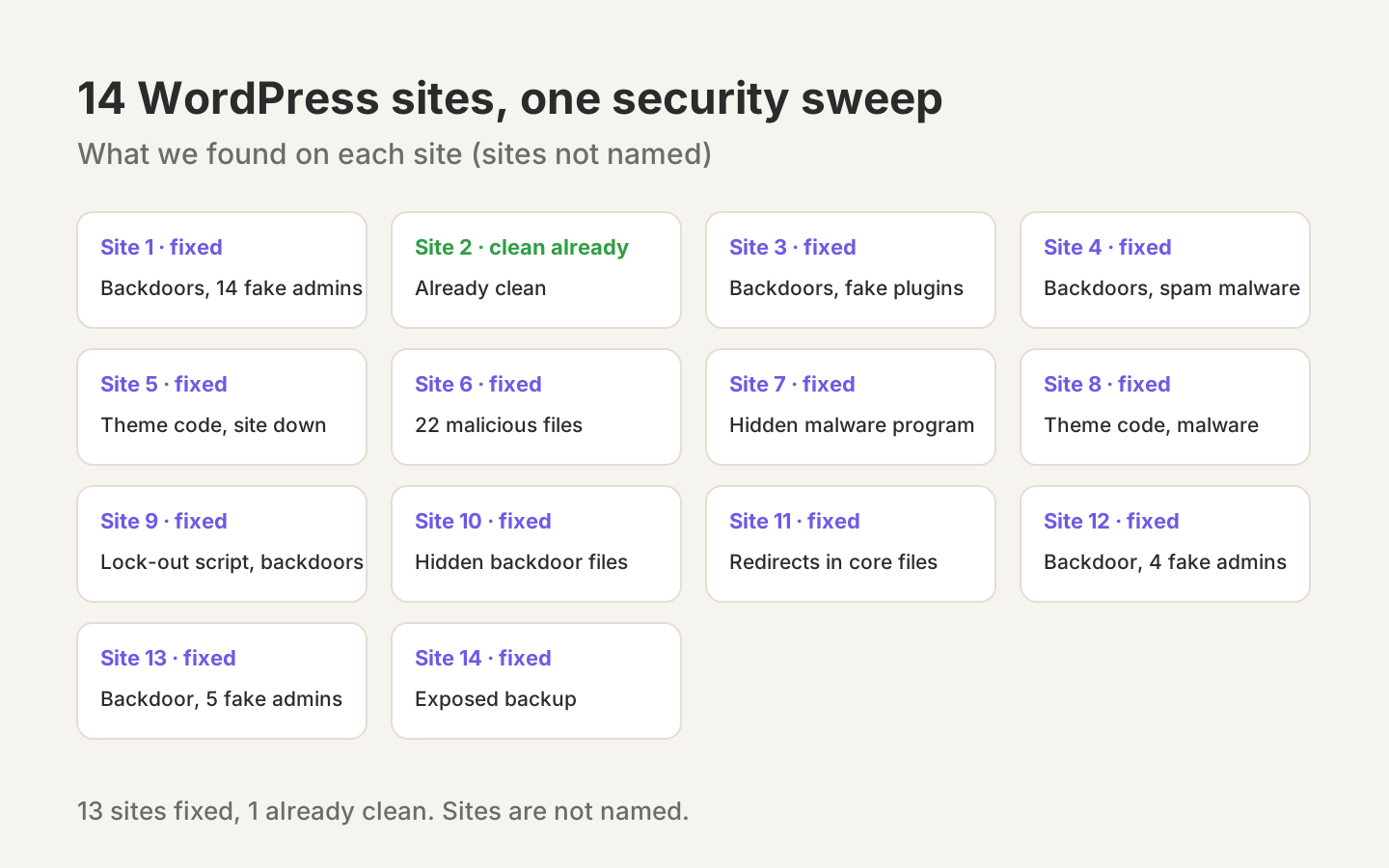
Abner then checked 14 of the client’s business websites and cleaned what he found.
| What we found | Where |
|---|---|
| Hidden backdoors and fake plugin or theme files | Most of the sites |
| Fake admin accounts made by the hacker | At least 24, across 4 sites |
| A “helper” plugin hiding a fake admin account | 1 site |
| 22 malicious files, including a hidden file manager | 1 site |
| Spam and redirect malware, one copy disguised inside WordPress core files | 3 sites |
| Malicious code injected into the theme | 2 sites |
| A hidden hacker database account | 1 site |
| A script that locked the owner out of the server account | 1 site |
| Old backups that anyone could download | 3 sites |
Where WordPress itself was tampered with, we reinstalled clean core files and reset the security keys. Real owner accounts were kept; only the hacker’s accounts were removed. On one site the cleanup also fixed a site-down error.
The result
Of the 14 sites, 13 were cleaned or secured, and 8 of them were checked again afterwards and verified clean. One was scanned fully and was already clean, so nothing was changed there. The hacker’s admin accounts are gone, and the exposed backups are out of public view.
Two of the skincare sites had a deeper story: earlier cleanups kept failing because of a hidden backdoor. That one has its own case page.
Why the backdoors matter
A hacked site that is only partly cleaned often gets reinfected within days, because the attacker still has a way in. Removing the backdoors and the fake accounts, and changing every database user and password, closes those ways in, so the cleanup lasts.
The honest note
This was real client work, so the client and the sites are not named, and we show no screenshots of them. The diagram on this page lists what we found, not the sites themselves.